Rafi Ibn Sultan
I build vision–language systems that segment, ground, and reason about the world.
On the academic job market. I'm seeking tenure-track Assistant Professor and Research Scientist positions, starting after I complete my Ph.D. in August 2027. Get in touch — I'd be glad to talk.
I'm a Ph.D. candidate in Computer Science at Wayne State University, working at the intersection of computer vision and multimodal AI. Since joining the Trustworthy AI Lab in 2022, I've worked on vision–language models and segmentation foundation models across medical imaging, mobility infrastructure, and remote sensing.
My research is about how vision–language models learn to understand and reason about space. A model can describe a scene accurately and still struggle to say how to move through it — which object blocks the path, how far away it is, what that means for the next step. Where the image leaves those relationships unclear, a confident answer can rest on a single plausible reading, and an early misjudgment carries forward into everything that follows. I work on models whose spatial claims are grounded in visual evidence rather than asserted.
Per Google Scholar, November 2026.
What I work on
Grounded Multimodal Reasoning for Accessibility
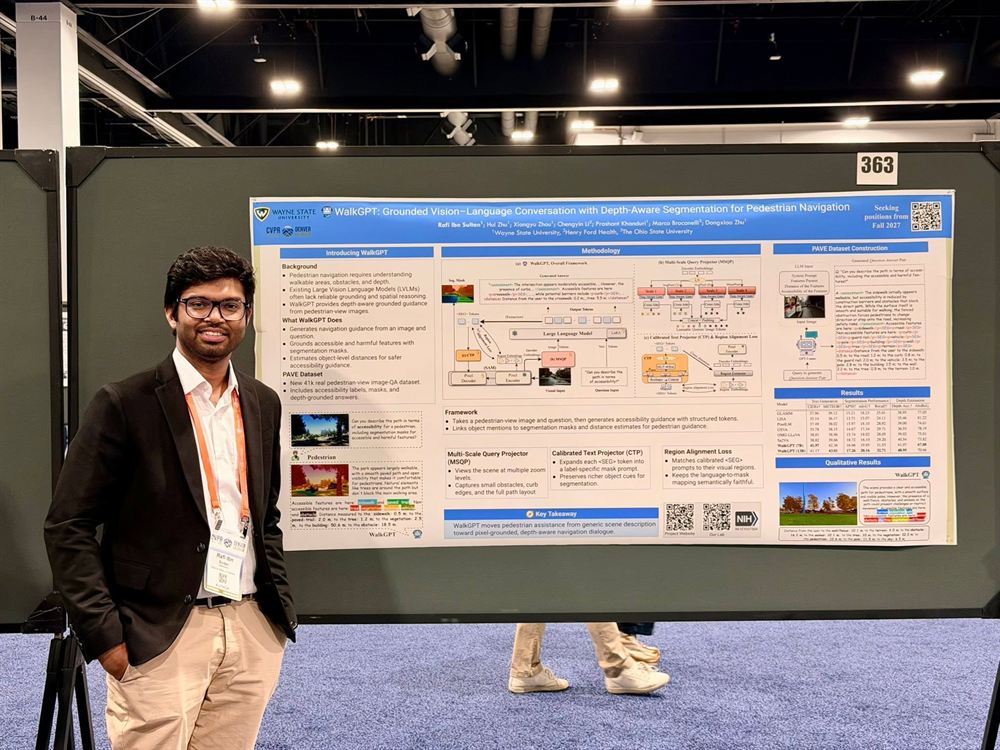
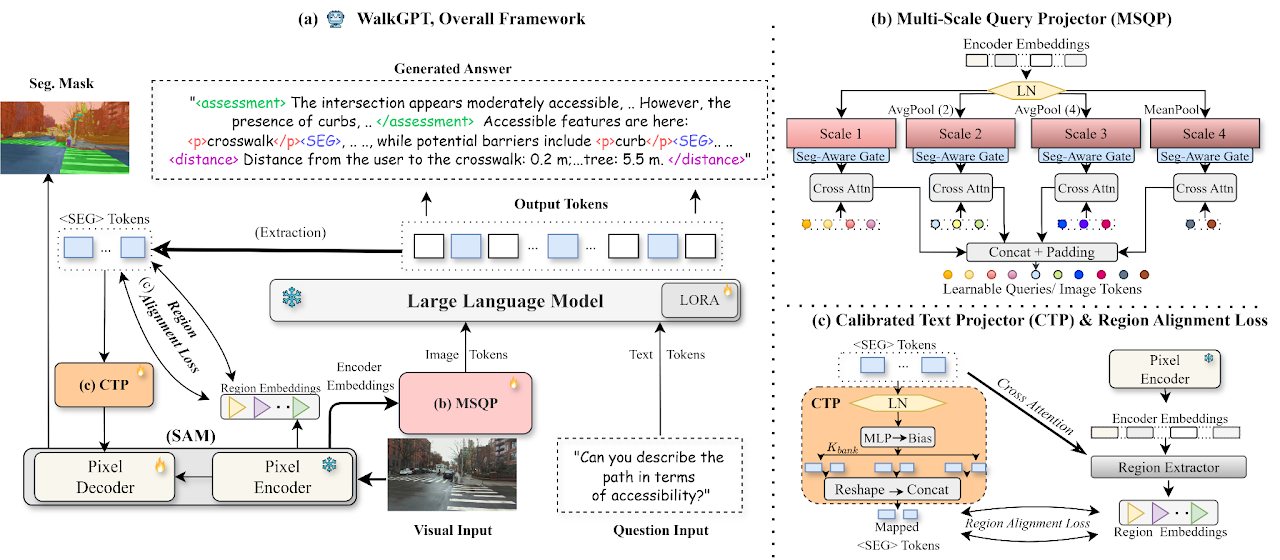
My work, WalkGPT (CVPR 2026), is a grounded vision–language model for pedestrian navigation and accessibility. It combines segmentation, depth estimation, and language reasoning to identify sidewalks, crosswalks, curb ramps, and accessibility barriers from real-world pedestrian-view imagery, then delivers step-by-step, context-aware guidance as a conversational agent.
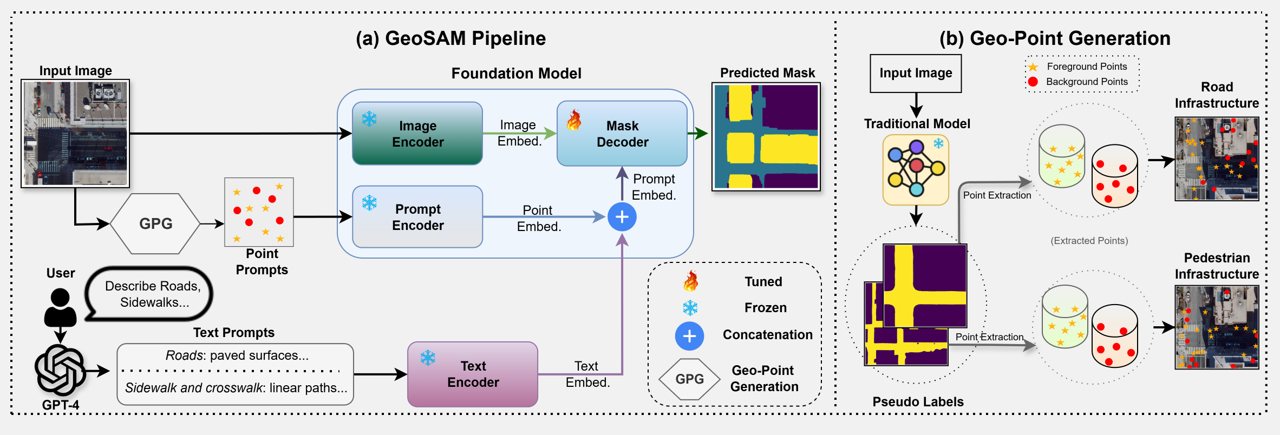
Earlier in this line, GeoSAM (ECAI 2025) introduced sparse- and dense-prompt fine-tuning of SAM for large-scale mobility-infrastructure segmentation from aerial and street-level imagery. It has since been adopted as a benchmark in subsequent NeurIPS work.
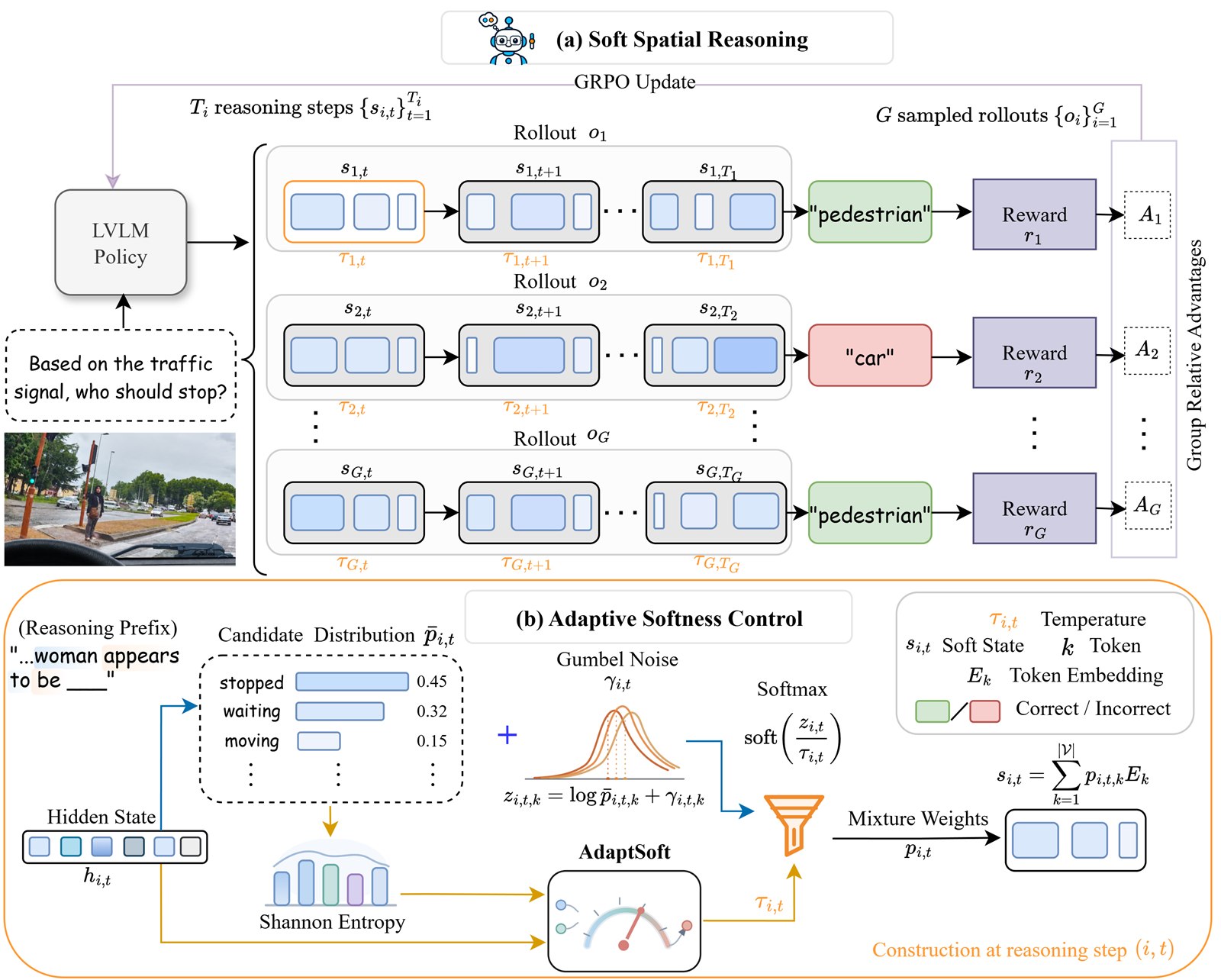
I'm currently extending this toward stronger spatial reasoning in vision–language models at scale. SpatialCORE (under review) targets spatially confident reasoning in large VLMs — pushing past surface-level description toward predictions that are grounded in visual evidence rather than asserted.
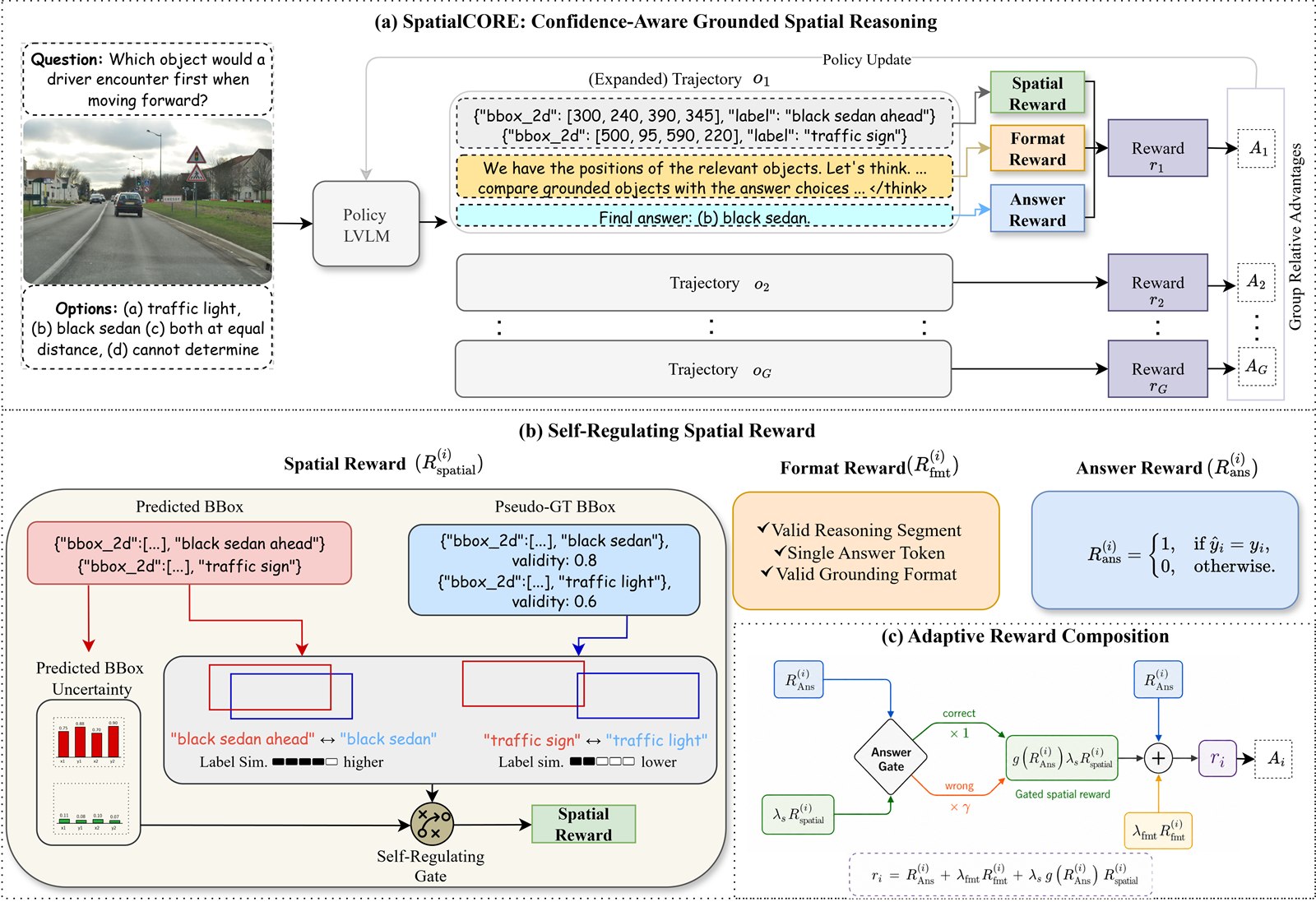
My most recent work, Soft Spatial Reasoning (under review), goes after how these models think. Chain-of-thought makes an LVLM commit to one discrete token at every reasoning step, even where the spatial interpretation is still uncertain — and a single early mistake then propagates through everything that follows. Instead of committing, the model carries a continuous soft state that mixes candidate token embeddings, letting several readings of a scene stay alive at once. The catch is that the right amount of softness varies step to step: holding on to rival candidates preserves a useful interpretation, but blending ones that imply contradictory spatial relations only muddies what comes next. AdaptSoft, a learned controller, reads the hidden state and the model's own predictive uncertainty to set that degree of softness at each step, trained by a gradient-alignment objective that needs no step-level reasoning supervision. Across spatial benchmarks it beats both hard and fixed-soft chain-of-thought on the same backbone. Code is on GitHub.
Medical Image Segmentation & Multimodal Learning
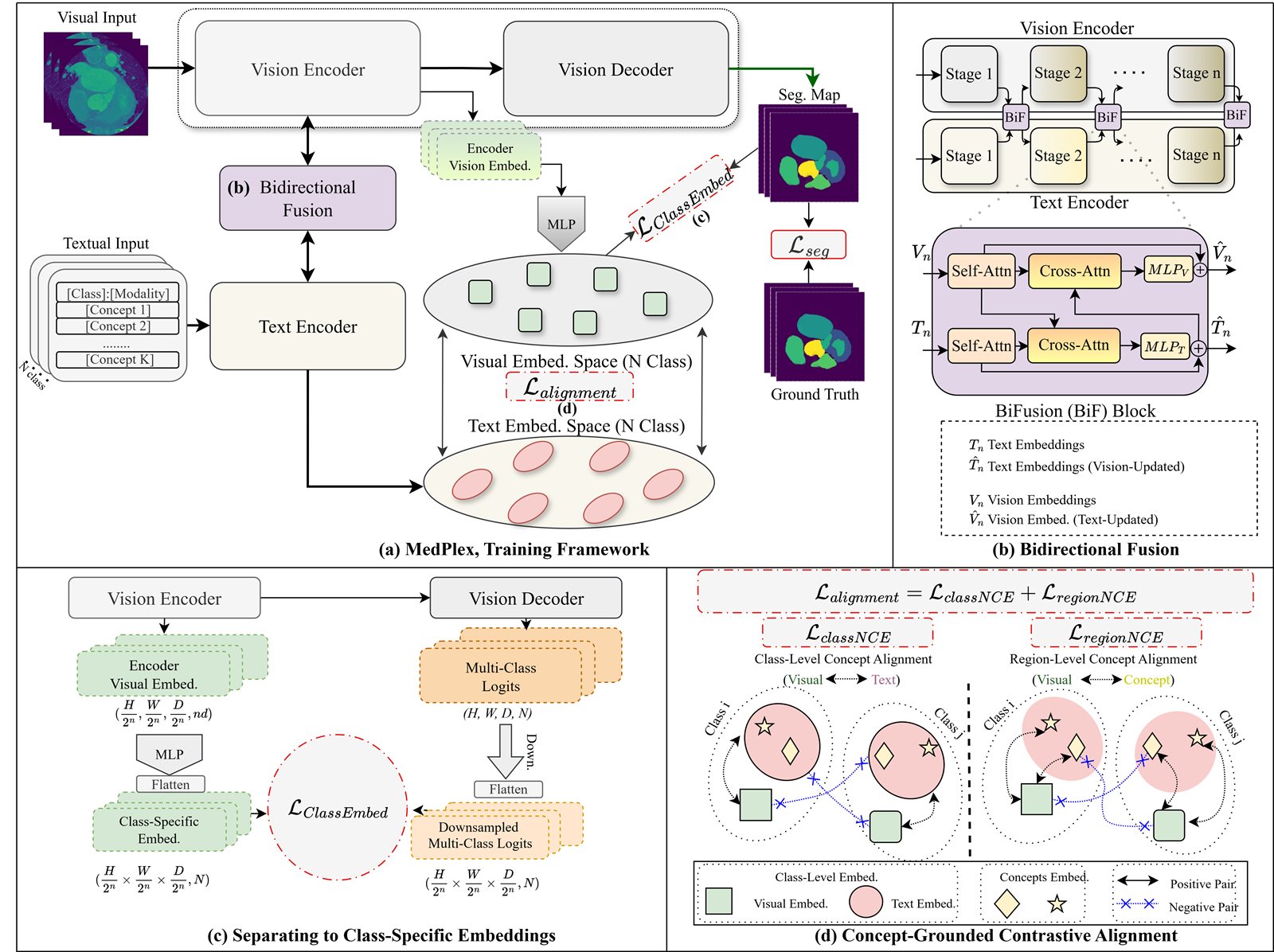
I develop foundation-model-based segmentation and VLM-driven fusion methods for CT and MRI analysis. My current work in this line, MedPlex, explores deep vision–language co-adaptation for clinically grounded medical segmentation — building on BiPVL-Seg, which introduced bidirectional progressive alignment of visual features with structured medical text to improve organ and tumor segmentation.
collaborated with Henry Ford Health, I work on Left Anterior Descending (LAD) artery segmentation using novel encoder–decoder architectures — important for radiotherapy planning, since the LAD is highly sensitive to radiation injury. That work was presented at AAPM 2025 and is forthcoming in Medical Physics.
Technical Skills
- Python
- PyTorch
- Linux
- Git
- LaTeX
- Multi-GPU training
- Vision transformers
- SAM
- Large vision–language models
- LoRA / PEFT
- Contrastive learning
- Segmentation
- Grounding
- Representation learning
- HuggingFace
- MONAI
- OpenCV
- scikit-learn
- Weights & Biases
Selected work
-
CVPR 2026
-
ECAI 2025
-
Medical Physics 2026

-
BMVC 2026
All Peer-Reviewed Publications
-
CVPR · 2026
-
Medical Physics · 2026
-
BMVC · 2026
-
Towards Mitigating Deceptive Safety Alignment in Large Reasoning ModelsNeurIPS · 2026
-
Partition-Aware Unlearning for Removing Spurious Correlations in Large Vision-Language ModelsNeurIPS · 2026
-
On Federated Compositional Optimization: Algorithms, Analysis, and GuaranteesTMLR · 2026
-
FluenceFormer: Transformer-Driven Multi-Beam Fluence Map Regression for Radiotherapy PlanningMIDL · 2026
-
ECAI · 2025
-
Enhancing CT Image Segmentation Accuracy Through Ensemble Loss Function OptimizationMedical Physics · 2025
-
AutoProSAM: Automated Prompting SAM for 3D Multi-Organ SegmentationWACV · 2025
-
MulModSeg: Enhancing Unpaired Multi-Modal Medical Image Segmentation with Modality-Conditioned Text Embedding and Alternating TrainingWACV · 2025
-
Medical Physics · 2023
-
MICCAI · 2023
-
ICAEEE · 2022
-
ICEEICT · 2021
-
ISCAIE · 2021
-
TENCON · 2018
-
ICEEICT · 2018
Preprints & Under Review
-
Under review · 2026
-
Under review · 2026
-
arXiv:2503.23534 · 2025
Full list on Google Scholar.
Talks, coverage & recognition
Awards & Honors
-
Outstanding Graduate Research Assistant Award 2025
Conference Reviewing
- ICLR 2027
- AAAI 2027
- NeurIPS 2026
- ACL Rolling Review 2026
- IJCAI-ECAI 2026
- BMVC 2026
- IJCNN 2025
- ECCV
Journal Reviewing
- Pattern Recognition
- Computer Vision and Image Understanding
- IEEE Transactions on Circuits and Systems for Video Technology
- Knowledge-Based Systems
- Computer Methods and Programs in Biomedicine
- Computers in Biology and Medicine
- Biomedical Signal Processing and Control
- Results in Engineering
- Medical Image Analysis
- Expert Systems with Applications
- IEEE Transactions on Medical Imaging
References
Director, Institute for AI and Data Science
Wayne State University dzhu@wayne.edu
Department of Radiation Oncology
Henry Ford Health kthind1@hfhs.org
Department of Electrical and Computer Engineering
The Ohio State University brocanelli.1@osu.edu
Department of Computer Science
Wayne State University khanduri.prashant@wayne.edu
Recent updates
- Oct 26, 2026 The presentation for MedPlex — to be presented at BMVC 2026 in Lancaster, UK this November — has been released. Watch it here.
- Oct 1, 2026 Two new preprints are now on arXiv: "Soft Spatial Reasoning" (paper, code) and "SpatialCORE: Confidence-Aware Grounded Spatial Reasoning in Large Vision–Language Models" (paper, code).
- Sep 25, 2026 Two co-authored papers have been accepted to NeurIPS 2026: "Towards Mitigating Deceptive Safety Alignment in Large Reasoning Models" and "Partition-Aware Unlearning for Removing Spurious Correlations in Large Vision-Language Models."
- Sep 4, 2026 Our work with Henry Ford Health, "A Neighborhood Attention Transformer Network for Enhanced 3D Segmentation of the Left Anterior Descending Artery," is now officially published in Medical Physics. Read it here, or the open-access version on arXiv.
- Aug 7, 2026 Our paper "MedPlex: Deep Vision-Language Co-Adaptation for Clinically Grounded Medical Segmentation" has been accepted to the British Machine Vision Conference (BMVC 2026), taking place 23–26 November 2026 in Lancaster, UK.
- Aug 4, 2026 Our paper with Henry Ford Health, "A Neighborhood Attention Transformer Network for Enhanced 3D Segmentation of the Left Anterior Descending Artery," has been accepted to Medical Physics.
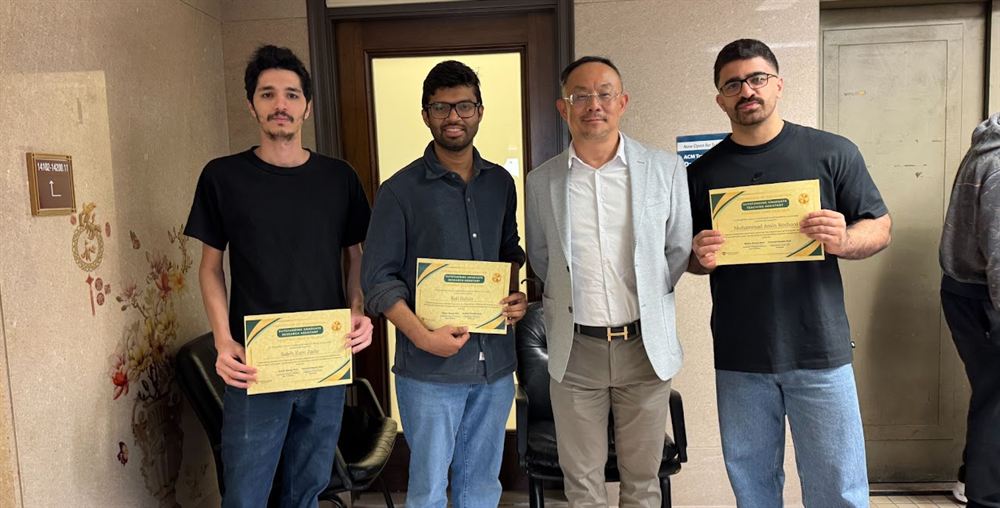
- Apr 16, 2026 Received the Outstanding Graduate Research Assistant Award for 2025 from the Department of Computer Science at Wayne State University.
- Feb 20, 2026 WalkGPT has been accepted to CVPR 2026.
- Jan 27, 2026 I was invited as a guest graduate speaker in the Computer Science Department at Wayne State University, presenting "From Mobility Infrastructure Segmentation to Pedestrian Guidance: A Multimodal AI Perspective."
- Jul 11, 2025 GeoSAM has been accepted to the 28th European Conference on Artificial Intelligence (ECAI 2025) in Bologna, Italy.
- May 16, 2025 Invited to review for Pattern Recognition — a third invitation from a Q1 journal, following Biomedical Signal Processing and Control and Computer Vision and Image Understanding.
- Apr 25, 2025 Our work NA-UNETR was presented as a poster at AAPM 2025.
- Apr 1, 2025 BiPVL-Seg, our multimodal segmentation model, is now on arXiv.
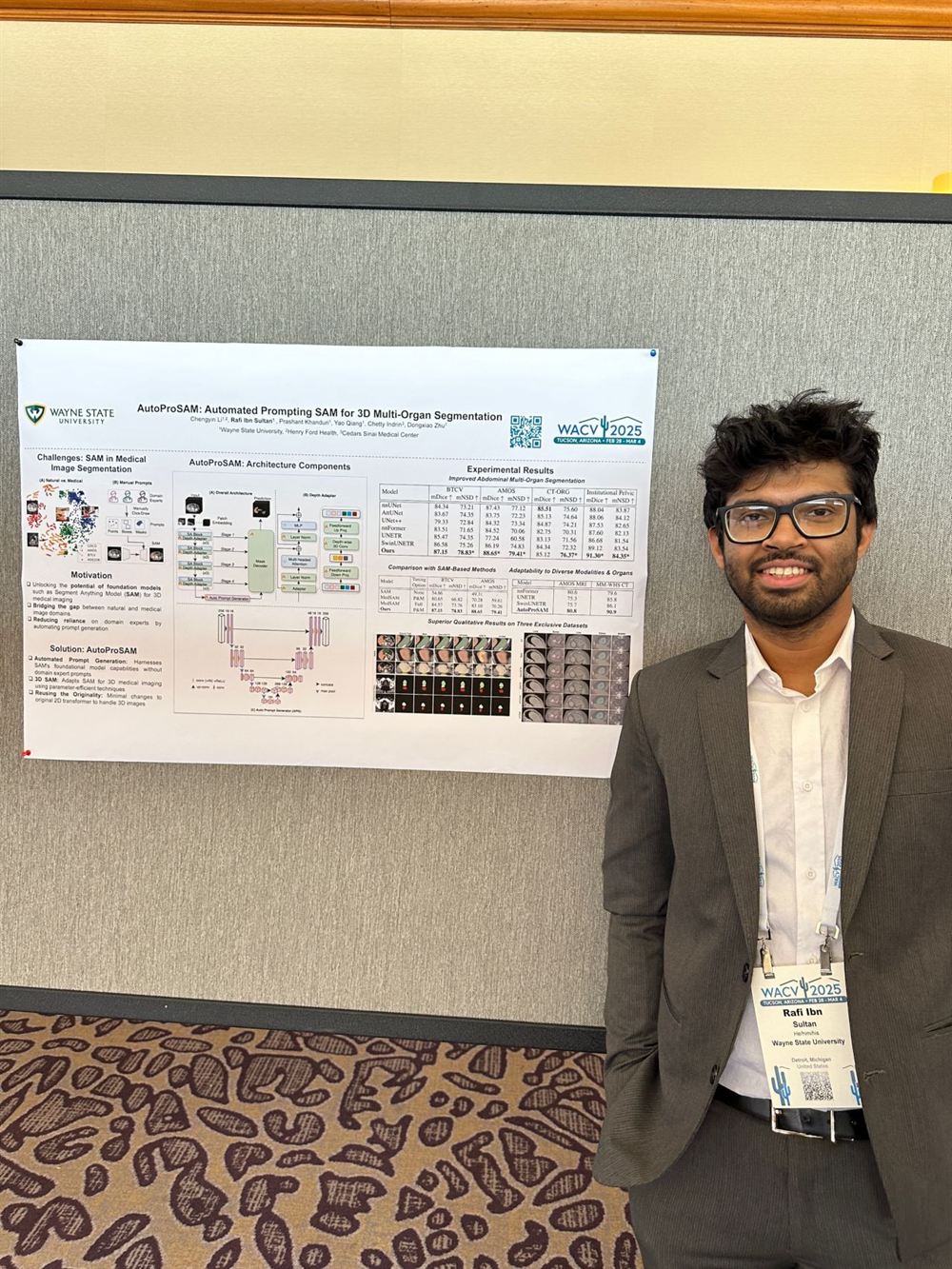
- Feb 27, 2025 Attended and presented AutoProSAM at WACV 2025. Watch the presentation.
- Feb 11, 2025 Invited to serve as a reviewer for IJCNN 2025.
- Oct 28, 2024 Two of our papers were accepted to WACV 2025.
- Apr 3, 2024 Our lab and GeoSAM were featured on Detroit PBS. Watch the segment.
- Mar 7, 2024 I passed my PhD qualifying exam and am now a PhD Candidate. Read the report.
Where I've worked
-
Graduate Research Assistant Sep 2023 — Present
- Lead independent research on grounded vision–language models for spatial reasoning, pedestrian navigation, and medical image segmentation — from problem formulation through publication, resulting in first-author papers at CVPR and ECAI.
- Drive an ongoing clinical collaboration with Henry Ford Health on coronary CT segmentation — developing and validating a deep learning method for left anterior descending artery segmentation from non-contrast planning CT, alongside medical physicists and clinical researchers.
- Mentor junior Ph.D. students on research methodology, experimental design, and paper writing.
-
Guest Lecturer — CSC 5991 Winter 2026
- Taught the large vision–language model portion of this graduate course.
-
Graduate Teaching Assistant Aug 2022 — Aug 2023
- Led Software Engineering labs, supervising 5–6 project teams of 4–5 students each per term through the full development lifecycle, from requirements to delivery.
-
Lecturer Oct 2019 — Aug 2022
- Sole instructor for undergraduate courses including Microprocessor and Assembly Language, Object-Oriented Programming, and Computer Fundamentals — 30–40 students per course.
- Supervised roughly 8 undergraduate final-year thesis and capstone projects from proposal to defense.
Education
-
Ph.D. in Computer Science Sep 2022 — Expected Aug 2027
-
M.Sc. in Computer Science Dec 2025
-
B.Sc. in Computer Science & Engineering 2014 — 2018
-
Higher Secondary School Certificate 2013
-
Secondary School Certificate 2011
Outside the lab
- Football — a lifelong Real Madrid loyalist, and I'll defend Cristiano Ronaldo in any argument
- Anime — always mid-series, always open to recommendations
- Camping — weekends under canvas whenever the season allows
- Hiking — trails are where I do my best thinking
- Gaming — FIFA since '98, a Killjoy main in Valorant, and new to CS2
- Movies & series — a reliable way to lose an evening
- Beginner acoustic guitarist
- Travel — working toward all 50 states
Conferences & Lab Life